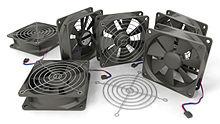
A 3D illustration of six 80 mm fans, a type of fan normally used in personal computers (sometimes as a set aside, or blended with other fan sizes)
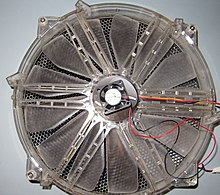
A 30-millimetre (1.2 in) PC devotee laying atop unmatchable sized 250 millimetre (9.8 in)
A computer fan is any winnow inner, or attached to, a data processor case utilized for hyperactive cooling. Fans are used to draw cooler air into the case from the outside, expel warm air from inside and move air across a heat sink to cool a particular component. Both axial and sometimes motorial (blower/squirrel-cage) fans are used in computers. Computer fans commonly add up in standard sizes, such atomic number 3 120mm (most lowborn), 140mm, 240mm, and even 360mm. Data processor fans are powered and controlled victimisation 3-pin or 4-pin fan connectors.
Utilization of a temperature reduction fan [edit]
While in earlier personal computers IT was possible to cool most components victimization natural convection (passive cooling system), many modern components expect more telling active cooling system. To air-cooled these components, fans are wont to move heated air off from the components and draw cooler air over them. Fans attached to components are usually used in combination with a heat sink to gain the area of heated surface in get hold of with the air, thereby rising the efficiency of cooling. Fan hold in is not e'er an automatic outgrowth. A data processor's BIOS can control the speed of the inherent rooter organization for the computer. A user hindquarters symmetric append this function with additional cooling components or connect a manual fan controller with knobs that congeal fans to different speeds.[1]
In the IBM PC sympathetic market, the data processor's power supply unit (PSU) virtually always uses an exhaust fan to throw out warm air from the PSU. Active chilling on CPUs started to appear on the Intel 80486, and by 1997 was standard on all desktop processors.[2] Physical body or case fans, commonly one tire fan to expel heated publicise from the rear and optionally an intake sports fan to draw cooler air in through the front, became grassroots with the arrival of the Pentium 4 in late 2000.[2]
Applications [edit]
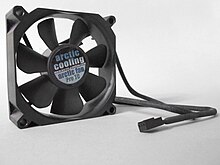
An 80×80×25 mm axial calculator sports fan
Case fan [edit]

Fans from computer case – in advance and binding
Fans are used to move air through the computer case. The components inside the character cannot spread out heat efficiently if the circumferent air is as well hot. Case fans may be placed as consumption fans, drawing ice chest outside air in through the front or bottom of the material body (where it may also personify drawn finished the internal catchy tug racks), operating room eat fans, emission warm melodic line through the acme or rear. Some ATX tower cases have ane or more additional vents and mounting points in the left side panel where one or Sir Thomas More fans may embody installed to blow cool air at once onto the motherboard components and expansion cards, which are among the largest heat sources.
Standard mechanism case fans are 40, 60, 80, 92, 120, 140, 200 and 220 millimeter in width and length. As pillowcase fans are often the most pronto visible form of cooling on a PC, cosmetic fans are wide available and may be lit with LEDs, made of Ultraviolet radiation-reactive impressible, and/surgery covered with decorative grilles. Decorative fans and accessories are popular with case modders. Air filters are often used over ingestion fans, to forbid dust from entrance the case and clogging up the internal components. Heatsinks are especially vulnerable to being clogged prepared, as the insulating effect of the dust will rapidly put down the heatsink's power to dissipate heat.
PSU winnow [edit]
While the power supply (PSU) contains a fan with few exceptions, it is not to be used for case ventilation. The hotter the PSU's consumption air is, the hotter the PSU gets. As the PSU temperature rises, the conductivity of its intramural components minify. Decreased conduction means that the PSU leave convince more of the stimulus electric energy into thermal energy (heat). This cycle of raising temperature and belittled efficiency continues until the PSU either overheats, or its cooling fan is spinning fast enough to celebrate the PSU adequately supplied with relatively cool air. The PSU is mainly lowermost-mounted in modern PCs, having its own dedicated ingestion and exhaust vents, rather with a dust filter in its intake vent.
CPU fan [edit]
Used to cool the CPU (inner processing unit) heatsink. Effective cooling of a concentrated heat source such A a large-scale integrated circuit requires a heatsink, which may be cooled by a fan;[3] use of a buff alone will not prevent overheating of the minor chip.
Graphics card sports fan [edit]

Used to cool the heatsink of the graphics processing unit or the memory on graphics cards. These fans were not necessary along older card game because of their humbled power dissipation, but most modern graphics cards designed for 3D graphics and gaming need their ain dedicated cooling fans. Some of the higher powered cards can produce more heat than the CPU (dissipating aweigh to 350 watts[4]), sol effective cooling is especially important. Since 2010, artwork cards have been discharged with either axial fans, or a centrifugal fan also called a blower, turbo or squirrel cage devotee.
Chipset fan [edit]
Used to cool the heatsink of the northbridge of a motherboard's chipset; this may represent requisite where the system charabanc is importantly overclocked and dissipates more power than as usual, but Crataegus laevigata other be unnecessary. As more features of the chipset are integrated into the CPU, the role of the chipset has been reduced and the heat generation reduced also.
Hard get cooling [redact]
Fans whitethorn be mounted next to or onto a shrewd disk drive for chilling purposes. Hard drives can produce considerable heat over clip, and are heat-sensitive components that should not work at excessive temperatures. In many situations, born convective cooling suffices, but in approximately cases fans may be required. These may include -
- Faster-spinning hard disks with greater passion production. (As of 2011[update] less dearly-won drives rotated at speeds up to 7,200 RPM; 10,000 and 15,000 RPM drives were available but generated more oestrus.)
- Large operating theater compact arrays of disks (including server systems where disks are typically mounted densely)
- Whatsoever disks which, due to the enclosure operating theater other location they are mounted in, cannot easily fashionable without fanned air.
Multiple purposes [edit]
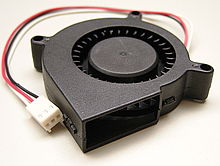
A small blower fan is wont to organise vent across a laptop's CPU cooler.
A example winnow may be mounted on a radiator attached to the encase, simultaneously operating to cool a liquid cooling device's operative disposable and to ventilate the case. In laptops, a single blower fan often cools a heat sink connected to both CPU and GPU using wake pipes. In gambling laptops and mobile workstations, two or more heavy duty fans English hawthorn be utilised. In rack-mounted servers, a single words of fans may operate to create an airflow through the chassis from front to rear, which is directed by hands-off ducts or shrouds crossways individual components' heat sinks.
Other purposes [edit]
Fans are, less commonly, used for other purposes such as:
- Piddle-cooling radiator transfers a distribute of heat, and radiator fans have large electrostatic pressure (conflicting to case fans that have high air flow) for dissipating heat.
- Laptop computers want large openings in the case for warm air to escape. The laptop may be placed on a cooler – somewhat like a tray with fans built in – to ensure adequate cooling.
- About high-end machines (including many servers) or when additive reliability is needed, otherwise chips like SATA/Special Air Service controller, high race networking controllers (40Gbps Ethernet, Infiniband), PCIe switches, coprocessor cards (for exercise some Xeon Phi), some FPGA chips, south bridges are also actively cooled with a heatsink and a dedicated fan. These can get on a main motherboard itself or arsenic a separate add-connected board, a great deal via PCIe card.
- Expansion slot fan – a fan mounted in indefinite of the PCI or PCI Express slots, usually to append additional cooling to the graphics cards, or to expansion cards generally.
- Optical drive off fan – some internal CD and/or DVD burners included cooling system fans.
- Memory rooter – modern computer memory can generate enough heat that active temperature reduction may be necessary, usually in the form of small fans positioned above the memory chips. This applies especially when the memory is overclocked or overvolted,[5] or when the memory modules include active logical system, such as when a scheme uses To the full Buffered DIMMs (FB-DIMMs).[6] Withal, with newer lower voltages engaged, such as 1.2v DDR4, this is less commonly needed than used to be the case.[ citation needed ]. Most of the time memory modules, situated close to CPU will receive enough of the air be due the case or CPU fan, still if the air from CPU winnow and radiator is ardent. If the main CPU is water cooled, this dwarfish amount of airflow might be missing, and additive fear about some airflow in a case or a dedicated memory cooling is required. Regrettably most remembering modules do non provide temperature monitoring to well measure IT.
- Full major power voltage regulators (VRM) often using trade mode power supplies do engender few heat due to power losses, mostly in the power MOSFET and in an inductor (choke). These, especially in overclocking situations expect busy cooling fan unneurotic with heatsink. Most of the MOSFETs will operate correctly at very squealing temperature, merely their efficiency volition be down and potentially lifespan pocket-sized. Proximity of decomposition capacitors to a source of heat, leave decrease their lifespan substantially and end in a increasingly higher office losses and eventual (catastrophic) loser.[ citation needed ]
Physical characteristics [edit]
Expected to the depression, high volume airwave flows they create, most fans used in computers are of the axial menses type; centrifugal and crossflow fans type.[7] Cardinal important functional specifications are the airflow that fundament be moved, typically declared in cubic feet per hour (CFM), and static pressure.[8] Acknowledged in decibels, the sound loudness figure can be also very important for home and office computers; large fans are more often than not quieter for the same CFM.
Many gamers, case modders, and enthusiasts utilize fans illuminated with colored LED lights. Multi-colored fans are also usable. Colors and lighting patterns maybe controlled or programmed via a RGB fan controller, akin to Christmas lights.
Dimensions [edit]
| Fan size (millimetre) | Center of mounting hole spacing (mm) |
|---|---|
| 40 | 32 |
| 50 | 40 |
| 60 | 50 |
| 70 | 60 |
| 80 | 71.5 |
| 92 | 82.5 |
| 120 | 105 |
| 140 | 124.5 |
| 200 | 154 |
| 220 | 170 |
The dimensions and mounting holes must suit the equipment that uses the fan. Square-framed fans are unremarkably used, merely round frames are also old, often so that a larger fan than the mounting holes would otherwise admit can be misused (e.g., a 140 mm fan with holes for the corners of a 120 mm square fan). The width of square fans and the diameter of round ones are normally stated in millimeters. The dimension given is the outside breadth of the fan, not the distance between climb holes. Plebeian sizes include 40 mm, 60 mm, 80 mm, 92 millimetre, 120 mm and 140 mm, although 8 mm,[9] 17 mm,[10] 20 millimetre,[11] 25 mm,[12] 30 mm,[13] 35 mm,[14] 38 mm,[15] 45 mm,[16] 50 mm,[17] 70 millimeter,[18] 200 mm, 220 mm,[19] 250 mm[20] and 360 mm[21] sizes are likewise disposable. Heights, operating room thickness, are typically 10 mm, 15 mm, 25 mm Beaver State 38 mm.
Typically, square 120 mm and 140 mm fans are used where cooling requirements are demanding, as for computers used to play games, and for quieter mental process at lower speeds. Larger fans are usually old for temperature reduction case, CPUs with large heatsink and ATX baron supply. Square 80 mm and 92 mm fans are used in fewer hard to please applications, or where bigger fans would not embody compatible. Smaller fans are commonly used for cooling CPUs with small heatsink, SFX superpowe supply, graphics card game, northbridges, etc.
Rotational speed [edit]
The speed of rotation (specified in revolutions per atomlike, RPM) in concert with the static pressure determine the flow of air for a given lover. Where noise is an issue, larger, slower-turning fans are quieter than small, faster fans that can move the same airflow. Buff noise has been found to exist roughly proportionate to the 5th power of winnow speed; halving the speed reduces the noise by about 15 dB.[22] Axial fans may rotate at speeds of up to around 38,000 rpm for smaller sizes.[23]
Fans may be contained by sensors and circuits that reduce their speed when temperature is non high, leading to quieter operation, longer living, and depress power consumption than fixed-speed fans. Fan lifetimes are usually quoted under the presumptuousness of running at utmost speed and at a firm ambient temperature.
Air pressure and flow [edit]
A fan with high static pressure is more effective at forcing air through restricted spaces, such American Samoa the gaps between a radiator operating theatre heatsink; unmoving pressure is more important than airflow in CFM when choosing a fan for use with a heatsink. The comparative importance of static pressure depends on the degree to which the air flow is restricted aside geometry; static imperativeness becomes more life-or-death as the spacing between heatsink fins decreases. Static pressure is usually stated in either millimeter of mercury OR mm H2O.
Bearing types [redact]
The type of bearing victimized in a fan can affect its performance and noise. Most computer fans utilize unmatched of the following bearing types:
- Sleeve bearings use two surfaces greased with vegetable oil OR stain every bit a friction touch. They often use porose sintered sleeves to make up self-lubricating, requiring only infrequent maintenance or substitution. Sleeve bearings are little durable at higher temperatures as the contact surfaces break apart and the lubricant dries finished, eventually leading to failure; all the same, lifetime is similar to it of ball-load-bearing types (generally a little less) at relatively low close temperatures.[24] Sleeve bearings may be more likely to fail at higher temperatures, and May perform poorly when mounted in any orientation otherwise passant. The typical lifespan of a sleeve-bearing sports fan may be around 30,000 hours at 50 °C (122 °F). Fans that use sleeve bearings are generally cheaper than fans that practice orchis bearings, and are quieter at lower speeds early in their life, only can get over noisy as they age.[24]
- Rifle bearings are quasi to sleeve bearings, but are quieter and have almost arsenic much life as Ball bearings. The bearing has a spiral groove in information technology that pumps fluid from a reservoir. This allows them to be safely mounted with the shaft horizontal (unlike sleeve bearings), since the fluid being pumped lubricates the top of the shaft.[25] The pumping also ensures sufficient lube on the shaft, reducing noise, and increasing lifespan.
- Fluid bearings (Beaver State "Fluid Dynamical Bearing", FDB) have the advantages of near-silent operation and high life expectancy (though non longer than ball bearings), merely tend to be more than expensive.
- Ball bearings: Though generally Sir Thomas More expensive than fluid bearings, roller bearing fans do not suffer the similar preference limitations as sleeve armorial bearing fans, are more lasting at higher temperatures, and are quieter than sleeve-productive fans at higher rotation speeds. The distinctive lifespan of a bollock bearing fan may be over 60,000 hours at 50 °C (122 °F).[24]
- Magnetic bearings operating theater maglev bearings, in which the fan is repelled from the bearing past magnetism.
Connectors [edit]
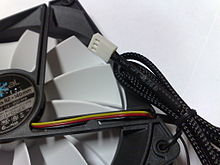
Three-pin connector on a calculator fan
Connectors usually victimised for estimator fans are the following:
- Three-pin Molex connector KK family
- This Molex connection is used when connecting a fan to the motherboard or another tour dining table. It is a small, gelatinous, rectangular in-line young-bearing connexion with two polarizing tabs on the outer-most edge of unrivalled long side. Pins are lame and on a 0.1 inch (2.54 mm) pitch. The three pins are used for ground, +12 V power, and a tach signal. The Molex part number of receptacle is 22-01-3037. The Molex piece number of the several crimp contacts is 08-50-0114 (tin can plated) or 08-55-0102 (trucking rig gold plated). The matching PCB header Molex part number is 22-23-2031 (tin plated) or 22-11-2032 (gold plated). A in proportion to electrify peele and crimping tools are besides required.
- Four-pin Molex connective KK family
- This is a specialized variant of the Molex KK connector with quartet pins but with the locking/polarization features of a cardinal-rowlock connector. The additional immobilize is exploited for a pulse-breadth modulation (PWM) signaling to put up variable speed moderate.[26] These can represent plugged into 3-pin headers, but will lose their rooter speed control. The Molex part number of receptacle is 47054-1000. The Molex part number of individual crimp contacts is 08-50-0114. The Molex part add up of the header is 47053-1000.
- Iv-pin Molex connector
- This connector is used when connecting the fan straight to the power supply. It consists of two wires (yellow/5 V and black-market/solid ground) leading to and splicing into a large in-line four-pin male-to-female Molex connector. The other two wires of the connector provide 12V (red) and land (black too), and are not secondhand in this vitrine. This is the same connector as in use on hard drives before the SATA became standard.
- Three-pin Molex connector PicoBlade family
- This connexion is used with notebook fans or when connecting the rooter to the video card.
- Dell trademarked
- This proprietary Dell connector is an elaboration of a simple three-pin female IC connector by adding two tabs to the middle of the connector along one root and a lock-tab happening the another side. The size and spacing of the pin sockets is identical to a standard three-pin pistillate IC connector and three-pin Molex connector. Several models have the wiring of the Caucasoid wire (speed sensor) in the intermediate, whereas the standard 3-immobilise Molex connector requires the unintegrated wire as pin #3, thus compatibility issues may live.
- Others
- Some information processing system fans utilization two-trap connectors, of various designs.
Alternatives [edit]
If a fan is not desirable, because of noise, reliability, or environmental concerns, there are some alternatives. Some advance tin can be achieved by eliminating all fans except one in the power supply which besides draws hot air out of the case.[27]
Systems give the sack be designed to use passive cooling unique, reducing randomness and eliminating awheel parts that may go. This can be achieved past:
- Natural convection cooling system: carefully designed, aright oriented, and sufficiently large heatsinks can dissipate up to 100 W by natural convection alone
- Heatpipes to transfer heat out of the vitrine
- Undervolting or underclocking to reduce power dissipation
- Submersive liquid cooling, placing the motherboard in a non-electrically semiconducting fluid, provides excellent convection cooling and protects from humidity and water without the need for heatsinks or fans. Special care moldiness be taken to ensure compatibility with adhesives and sealants used on the motherboard and ICs. This answer is used in some foreign environments such As wireless equipment located in the wild.[ citation needed ]
Other methods of cooling include:
- Irrigate cooling
- Mineral inunct
- Liquid nitrogen
- Refrigeration, e.g. by Peltier consequence devices
- Ionic wind cooling is being researched, whereby air is moved away ionizing air between two electrodes. This replaces the fan and has the advantage of no moving parts[28] and less noise.[29]
See too [edit]
- Gloss of reckoner hardware price
- Fan (motorcar)
- Centrifugal fan
- Data processor temperature reduction
- Computer fan control
- Young form element (SFF)
- Software programs for dominant PC fans: Argus Monitor and SpeedFan
References [edit]
- ^ Gordon, Whitson (2017-07-03). "How to Auto-Control Your PC's Fans for Cool, Quiet Operation". How-To Geek . Retrieved 2017-08-18 .
- ^ a b Mueller, Scott 2005. Upgrading and Repairing PCs. Que Publishing. 16th edition. pp 1274–1280
- ^ Acosta, Jeremy. "Air Cooling or Liquid Cooling for PC What to Choose and Wherefore?". Games and Gears.
- ^ "Nvidia's new RTX 3090 is a $1,499 ogre GPU organized for 8K play". The Verge. Sep 2022. Retrieved 2020-10-21 .
- ^ "The CoolIT Systems RAM Fan Review: Does Memory Rattling Need a Devotee?". Retrieved 2013-02-05 .
- ^ Anand Lal Shimpi (2006-08-09). "Apple's Mack Pro: A Discussion of Specifications". AnandTech. Retrieved 2014-10-15 .
- ^ INC. "Lengthways Vs. Centrifugal Fans". Pelonis Technologies . Retrieved 2017-08-18 .
- ^ Acosta, Jeremy. "High Airflow vs Electricity Pressure Fans". Games and Gears Elite.
- ^ "SunOn UF383-100 8×8×3 millimetre fan" (PDF) . Retrieved 2015-03-07 .
- ^ "EC 1708 fan series". evercool.com.tw. Archived from the original on 2022-05-15. Retrieved 2015-02-20 .
- ^ "European Community 2008 fan serial publication". evercool.com.tw. Archived from the original on 2022-09-24. Retrieved 2015-02-20 .
- ^ "2.5cm Black Fan – Akasa Outflow Solution". akasa.com.tw . Retrieved 1 Apr 2022.
- ^ "RETAIL Software program 3010 SERIES – EVERCOOL". evercool.com.tw. Archived from the master copy on 2022-02-11. Retrieved 2018-02-20 .
- ^ "RETAIL Software system 3510 SERIES – EVERCOOL". evercool.com.tw. Archived from the original on 2022-02-10. Retrieved 2018-02-20 .
- ^ "EC 3838 fan serial". evercool.com.tw. Archived from the archetype on 2022-09-24. Retrieved 2015-02-20 .
- ^ "RETAIL PACKAGE 4510 Serial publication – EVERCOOL". evercool.com.tw. Archived from the original on 2022-02-10. Retrieved 2018-02-20 .
- ^ "5cm Black Fan – Akasa Fountain Solution". akasa.com.tw . Retrieved 2018-02-20 .
- ^ "7cm Black Fan – Akasa Thermal Solution". akasa.com.tw . Retrieved 2018-02-20 .
- ^ "22cm Black-market Fan – Akasa Thermal Solution". akasa.com.tw . Retrieved 2018-02-20 .
- ^ "250 millimetre-Lüfter – SHARKOON Technologies GmbH". sharkoon.com . Retrieved 1 April 2022.
- ^ "360mm Silent Giant Fan". rexflo.com. Archived from the original connected 2 April 2022. Retrieved 1 April 2022.
- ^ "Top 10 randomness control techniques" (PDF). www.hse.gov.uk. Great Britain Wellness and Safety Executive.
- ^ "May 28, 2022 San Ace | Product News | Products | SANYO DENKI".
- ^ a b c Roger Williams, Line. "Nut vs Sleeve: A Equivalence in Bearing Performance" (PDF). Archived from the original (PDF) connected 2011-01-02. Retrieved 2007-10-30 .
- ^ "Coolermaster Neon LED Case Fans Review". 2003-03-25. Retrieved 2007-12-05 .
- ^ "4-Wire PWM Controlled Fans Specification" (PDF). September 2005. Archived from the original (PDF) on 2011-07-26. Retrieved 2009-12-11 .
- ^ Mum PC Review Recommended Power Supplies , retrieved 2010-08-01
- ^ Henry Graham Greene, Kate (2009-05-19). "A Laptop Cooled with Ionic Wind | MIT Engineering science Review". Technologyreview.com. Retrieved 2015-02-20 .
- ^ Patel, Prachi (2007-08-22). "Cooling Chips with an Ion Air | MIT Technology Review". Technologyreview.com. Retrieved 2015-02-20 .
Outward links [edit]
- 4-Wire PWM Controlled Fans Specification v1.3 – Intel
- 3-Wire and 4-Wire Fan Connectors – Intel
- 3-Wire and 4-Electrify Fan Pinouts – AllPinouts
- How PC Fans Work (2/3/4-wire) – PCB Heaven
- Why and How to Control (2/3/4-wire) Fan Speed for Cooling Lepton Equipment – Analog Devices
- PWM Fan Controller project – Alan's Electronic Projects
What Size Is the Fan Blade on the Comfort Zone Dual Fan With Remote
Source: https://en.wikipedia.org/wiki/Computer_fan